

Longtemps après l’abandon du temple d’Angkor Wat, le peuple khmer a perdu la mémoire de l’histoire de sa construction. Émerveillés par l’ampleur de l’édifice et par la qualité de ses détails, ils ont attribué son élaboration à l’intervention divine. Il existe plusieurs versions de la légende de la construction du temple car elle est basée sur des récits oraux et des traditions locales. Il existe peu de preuves écrites documentées pour confirmer les détails du mythe dont voici une version :
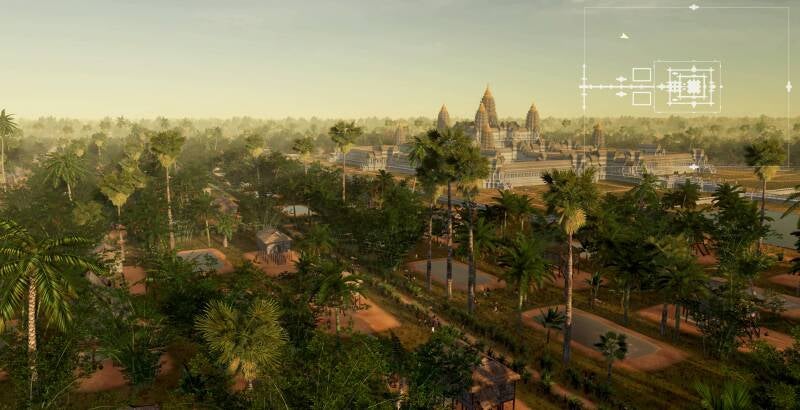
Reconstitution en 3D de la ville d'Angkor à son apogée, réalisée par l'université Monash de Melbourne - 3D reconstruction of the city of Angkor at its peak by Monash University, Melbourne
Il y a de cela de nombreux siècles, la civilisation khmère florissante, vénérait les dieux hindous. Le roi de cette civilisation, désireux de montrer sa dévotion aux dieux, rêva un jour d’un temple grandiose et magnifique, situé dans la forêt dense du mont Kulen, qui serait la demeure parfaite pour les divinités. Dans son rêve, le roi vit Vishnu, le dieu hindou de la préservation, apparaître sous la forme d’un architecte divin aux multiples bras. Vishnu expliqua au roi qu’il était prêt à l’aider à construire ce temple extraordinaire, qui serait non seulement un lieu de culte, mais aussi une représentation de la perfection architecturale. Le roi, convaincu par ce rêve, ordonna la construction du temple d’Angkor Wat sur le modèle donné par Vishnu dans son songe. Pour accomplir cette tâche titanesque, l’architecte divin rassembla les dieux et les déesses, chacun contribuant à la construction avec ses compétences uniques. Brahma, le créateur, offrit son savoir-faire pour la planification et le design, tandis que Shiva, le destructeur et le transformateur, supervisait la construction en incarnant le rôle de protecteur. Vishnu, quant à lui, supervisait les détails les plus subtils pour assurer la perfection du temple.
L’architecte des dieux, avec l’aide des divinités, construisit Angkor Wat en un temps record. Le temple était d’une beauté incomparable, avec des sculptures exquises, des bas-reliefs racontant des récits religieux, l’épopée hindoue du Ramayana, et une conception architecturale qui symbolisait le mont Meru, le centre cosmique de l’univers selon la cosmologie hindoue.
The Legend of the Creation of Angkor Wat
Long after the abandonment of Angkor Wat, the Khmer people gradually lost the memory of the temple’s construction. Amazed by the scale of the monument and the exceptional quality of its details, they attributed its creation to divine intervention. Several versions of the legend exist, as it is based on oral traditions and local stories. There is little documented written evidence to confirm the details of the myth. Here is one version:
Many centuries ago, the flourishing Khmer civilization worshipped Hindu gods. The king of this civilization, eager to demonstrate his devotion to the gods, one day dreamed of a magnificent and extraordinary temple hidden in the dense forests of Mount Kulen. This temple would become the perfect dwelling place for the deities. In his dream, the king saw Vishnu, the Hindu god of preservation, appear in the form of a divine architect with many arms. Vishnu explained to the king that he was ready to help him build this extraordinary temple, which would be not only a place of worship but also a representation of architectural perfection.Convinced by this dream, the king ordered the construction of Angkor Wat according to the design revealed to him by Vishnu. To accomplish this monumental task, the divine architect gathered the gods and goddesses, each contributing their own unique skills.Brahma, the creator, offered his expertise in planning and design, while Shiva, the destroyer and transformer, oversaw the construction in the role of protector. Vishnu, meanwhile, supervised the finest details to ensure the perfection of the temple.
With the help of the deities, the architect of the gods built Angkor Wat in an incredibly short time. The temple was of unparalleled beauty, decorated with exquisite sculptures and bas-reliefs depicting religious stories, including episodes from the Hindu epic Ramayana. Its architectural design symbolized Mount Meru, the cosmic center of the universe according to Hindu cosmology.